
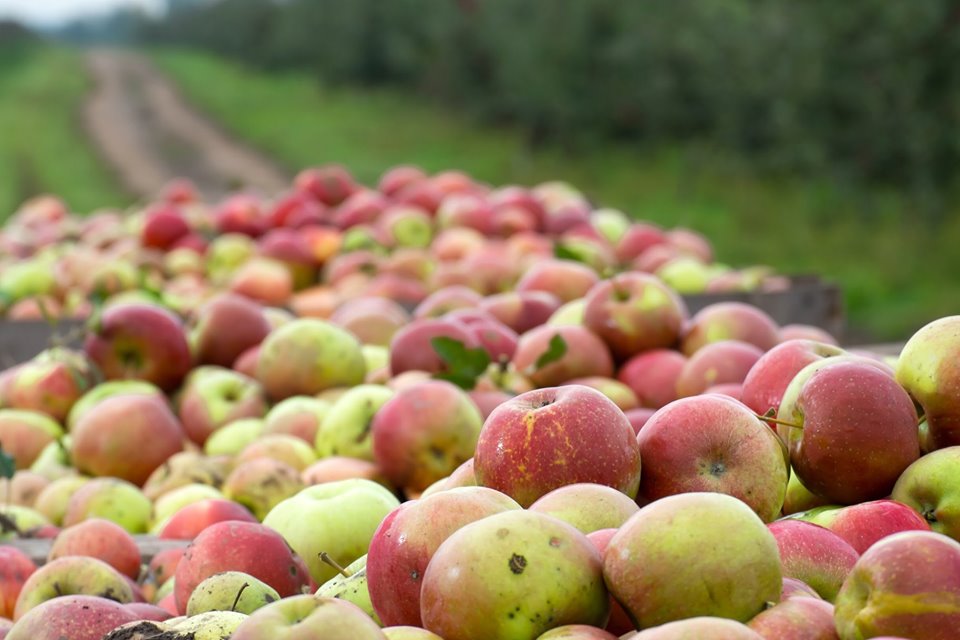
Polish growers are once again up in arms over processing apple prices. They are blaming processors, who are currently offering mostly €0.12–0.13 per kg for industrial apples. But the most interesting part is that EastFruit had already warned about exactly this scenario, explaining that attempts to shield the market from Ukrainian products could lead to a collapse in processing apple prices in Poland itself.
So what is happening, and why?
Poland is entering the harvest of late apple varieties, which means that in October–November apples coming directly from orchards, and later during the winter from storage, increasingly have lower acidity. As a result, the apple juice concentrate (AJC) produced from them is also predominantly “sweeter”, or lower-acid. For years, Polish processors dealt with this very simply: they bought higher-acid concentrate from Ukraine and blended it with Polish concentrate, obtaining a product with characteristics that better matched the requirements of international buyers.
But Ukraine now has only a 30,000-tonne duty-free quota for AJC supplies to the EU. Above the quota, concentrate is subject to a 30% import duty. Polish politicians and growers believe this protects local producers of lower-quality apples from low prices, but as we have repeatedly explained, the result is exactly the opposite.
If a tonne of concentrate costs, say, €1,800–2,000, the duty adds roughly another €540–600 per tonne. So far, so good. And this is where the paradox begins. Türkiye is now putting strong pressure on European prices with cheap low-acid concentrate, which competes directly with Polish low-acid concentrate. At the same time, Polish plants can no longer buy Ukrainian high-acid concentrate on the same favourable terms, blend it with their own product and increase the value of the final concentrate.
So cheap low-acid concentrate from Türkiye is pushing prices down, while Ukrainian high-acid concentrate, which helped Polish processors produce a higher-value product, has effectively become 30% more expensive because of the duty. As a result, Poland has fewer options for increasing the value of its own product and is forced to compete with Türkiye on price. This means Polish processors are being forced to reduce the prices they pay for domestically produced processing apples.
On 24 September, EastFruit published the article “How Poland and the EU lose tens of millions by restricting Ukrainian apple juice concentrate”. We explained directly that Poland is not simply an apple-producing country, but one of the key centres for processing, blending and exporting apple juice concentrate.
Then, on 28 September, in the article “Polish fruit business suffers from populism and loses positions on the markets of both fresh apples and AJC”, EastFruit effectively described today’s situation in advance:
“Additional costs mean lower margins for Polish processors.” The conclusion went even further: “…lower processor margins and additional pressure on procurement prices for Polish processing apples.”
In other words, EastFruit warned two weeks ago that restrictions on Ukrainian concentrate could result not in higher prices, but in lower prices for Polish growers.
Polish fruit business suffers from populism and loses positions on the markets of both fresh apples and AJC
And now, on 11 October, the Polish market is already showing exactly this: processors are barely raising procurement prices, while processing apples are priced at around €120–130 per tonne.
And now the main question for Polish growers: “Who is actually the bigger competitor? Ukraine, where the entire apple crop even in a good year is around 1.0–1.4 million tonnes, or Türkiye, which in normal production years is capable of producing around 4–5 million tonnes of apples, has already become one of the world’s largest producers and actively competes with Poland not only in apple juice concentrate, but also in the fresh apple market?”
If imports of Ukrainian concentrate are restricted, it does not mean that a Polish processor will necessarily buy more Polish apples. As EastFruit wrote on 28 September: “The missing volume will simply be replaced by concentrate from Türkiye, China or another country.” This is the fundamental mistake behind attempts to protect local producers through quotas and import duties.
The irony is that the policy was intended to protect Polish growers from Ukrainian concentrate. Instead, Ukrainian high-acid concentrate became more expensive for Polish processors because of the 30% duty, processors lost some of their ability to efficiently produce higher-value concentrate, Türkiye gained more room in the European market, processor margins fell, and processors were forced to reduce prices for locally produced processing apples, currently offering Polish growers only around €0.12–0.13 per kg.
They wanted to protect Polish apple growers from Ukraine, but ended up protecting Türkiye from a Ukrainian competitor at the expense of Polish apple growers.
Well done!
The use of the site materials is free if there is a direct and open for search engines hyperlink to a specific publication of the East-Fruit.com website.