
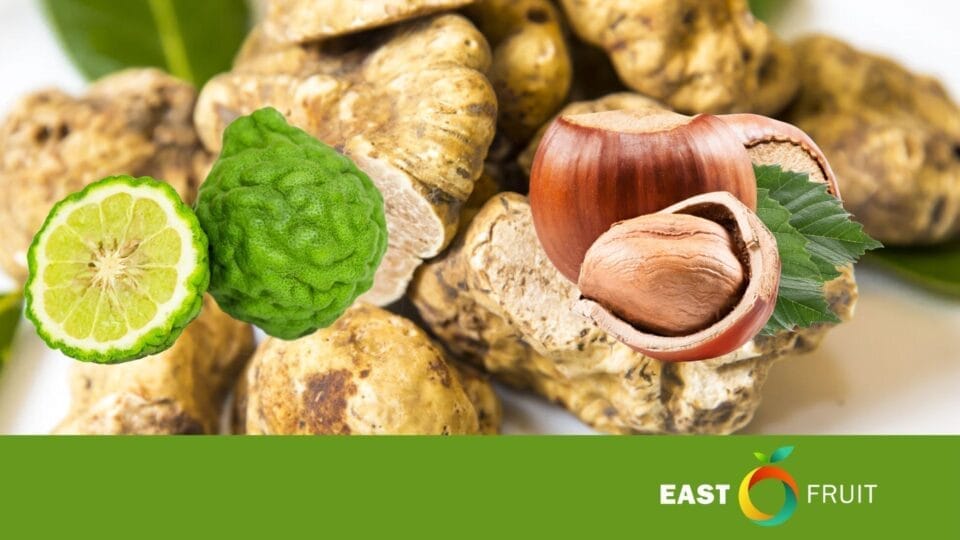
Extreme heat and prolonged rainfall shortages in Italy are hitting several high-value products at once — hazelnuts, bergamot and truffles. For the market, however, the problem goes far beyond lower yields: climate stress is affecting product size and quality, processing yields and the ability of individual production regions to supply buyers consistently. International agrimarketing and sustainable agriculture expert Kateryna Zvierieva explains why the real economic losses caused by climate stress may be significantly greater than the decline in harvested volumes alone would suggest.
Prolonged heat and rainfall shortages are having an increasingly visible impact on Italy’s high-value agricultural production. Hazelnut crop prospects are deteriorating in Piedmont, bergamot losses in Calabria could exceed 60%, while adverse conditions in Tuscany are creating risks for white truffle production.
According to EastFruit, citing data from Italian agricultural association Coldiretti, climate-related challenges are becoming increasingly widespread. Drought of varying severity has affected a significant share of the country, while agricultural losses caused by climate anomalies in 2026 are already running into billions of euros.
The situation with hazelnuts, bergamot and truffles is particularly relevant for international markets. In all three cases, climate stress can affect not only total production volumes but also the commercial value of the final product.
Hazelnuts: heat accelerated ripening but weakened crop prospects
The 2026 hazelnut harvest in Piedmont started earlier than usual. High temperatures accelerated ripening but at the same time negatively affected crop development.
According to Coldiretti, following an extremely difficult 2025 season for growers, initial production forecasts for this year are already being revised downward.
One of the main problems is premature nut drop. In addition, hazelnuts may be smaller, directly reducing kernel yields after shelling.
This is particularly important from a commercial perspective. The economic result for both growers and processors depends not only on the total volume harvested, but also on size, kernel quality and shelling yield. Financial losses may therefore prove greater than the decline in gross production alone would suggest.
Coldiretti notes that the coming weeks will be decisive for the final development of the hazelnut crop.
Bergamot: a regional climate shock with potential global consequences
The situation in Calabria is even more severe.
In the coastal area of Reggio Calabria province, high temperatures combined with a prolonged absence of rainfall are causing bergamot fruit to dry out. According to estimates by Coldiretti, losses this season could exceed 60%.
The problem is not limited to the number of harvested fruits. Much of bergamot’s commercial value comes from the essential oil extracted from its peel.
Under normal conditions, around 0.5 kg of essential oil can be obtained from 100 kg of bergamot fruit. Climate stress can therefore reduce both crop volumes and the yield of this valuable processed product.
For international markets, the situation is particularly important because bergamot production is highly geographically concentrated. According to the specialist Consorzio del Bergamotto, the overwhelming majority of global production is concentrated in Italy’s Calabria region.
As a result, severe drought affecting a relatively small production area could have consequences far beyond local agriculture — reaching processors and companies in the food, cosmetics and perfume industries that depend on bergamot oil.
Unlike more widely produced fruits, where importers can often compensate for shortages by switching suppliers or origins, bergamot supply is much more closely tied to a specific production area.
White truffles: the threat extends beyond the current harvest
Tuscany provides another important example, with prolonged heat threatening white truffle production.
High temperatures persisting since mid-July have severely dried out forest soils. The ground has become so hard that even trained truffle dogs are finding it more difficult to locate and dig up truffles.
But the potential longer-term impact is even more important.
Excessive heat and insufficient soil moisture may damage spores during a critical phase of white truffle development, potentially affecting future formation and production.
The extended dry spell disrupted the balance between soil moisture and temperature that had developed relatively favourably following winter and spring. Early warning signs are already visible. According to the Italian agricultural association, harvest volumes of summer black truffle, or scorzone, have declined in recent weeks despite a positive start to the season.
Unlike many agricultural crops, truffle supply cannot be rapidly restored simply by expanding production area or increasing irrigation. Climate-related disruption of forest ecosystems can therefore have longer-lasting consequences.
Kateryna Zvierieva: climate losses cannot be measured by tonnes alone
According to Kateryna Zvierieva, international expert in agrimarketing and sustainable agriculture and founder of Sapienza.media, the situation with Italian hazelnuts, bergamot and truffles clearly demonstrates how the economics of climate risk are changing.
“We are used to assessing drought in relatively simple terms: production was expected at a certain level, then falls by 10% or 20%, so we assume the market has lost roughly the same share of product. But for high-value agricultural products, this logic is becoming increasingly inadequate,” Zvierieva says.
According to the expert, climate stress can affect several product parameters simultaneously.
“Drought can alter fruit or nut size, quality, dry matter content, ripening periods and commercial processing yields. For hazelnuts, the yield of high-quality kernels matters. For bergamot, it is the amount of essential oil that can be extracted from the fruit. In the case of truffles, excessive heat and lack of moisture may affect the biological cycle of formation itself. Therefore, losing 10% of physical production does not necessarily mean losing only 10% of its economic value.”
This factor, she notes, is becoming increasingly important for international buyers. “Climate risk is gradually becoming part of procurement strategy. Buyers increasingly need to understand whether a supplier and its region of origin will be able to maintain stable volumes and the required quality over the coming years.”
Climate risk is moving through the entire supply chain
For the agri-food market, developments in Italy are significant for another reason: climate-related losses increasingly extend beyond the farm itself.
If drought reduces hazelnut size and kernel yield, processors are affected. If bergamot produces less essential oil, the impact reaches companies purchasing processed raw materials. If climate conditions disrupt truffle development, the supply of a product that cannot easily be replaced with equivalent volumes from another region becomes constrained.
In this way, climate risk moves progressively from the producer to the processor, trader and final buyer.
For high-value products, geographical risk is also becoming increasingly important. The more concentrated production of a particular product is within one region, the greater the potential impact of a local drought or other extreme weather event on the entire supply chain.
Drought affects more than 60% of Italy
The difficulties facing individual crops are part of a much broader problem.
According to Coldiretti, using Copernicus monitoring data, drought of varying severity affected more than 60% of Italy’s territory in early August.
In Piedmont, water reserves were around 30% below normal levels, while farms in northern regions have been forced to rely more heavily on irrigation, increasing production costs. The Italian agricultural association estimates that total losses to the country’s farming sector from drought, extreme weather and wildfires in 2026 have already exceeded €3 billion.
Coldiretti is calling for faster investment in water infrastructure and for the expansion of networks of small and medium-sized reservoirs capable of storing water when it is available and supplying farms during periods of drought.
Water and soil are becoming economic assets
However, additional water alone will not be sufficient for the long-term adaptation of agriculture, according to Kateryna Zvierieva. “Reservoirs and irrigation infrastructure are critical. But the challenge for modern agribusiness is to use every available cubic metre of water more efficiently,” she says.
In her view, risk-management systems need to combine precision irrigation, soil-moisture monitoring, improvements in soil structure and organic matter, the selection of adapted varieties and rootstocks, vegetation cover and more accurate forecasting of climate stress. “The ability of soil to absorb, retain and gradually release moisture is evolving from a purely agronomic indicator into an economic one. The more unstable the climate becomes, the clearer the link between soil health, water-use efficiency and the financial resilience of agricultural businesses,” Zvierieva stresses.
The next competitive advantage: the ability to fulfil contracts
Italy’s 2026 season shows that the concept of agricultural competitiveness is expanding.
Price, productivity, product quality, certification and efficient logistics remain essential. But another factor is becoming increasingly important — a producer’s ability to manage climate volatility. “For international buyers, producers capable of fulfilling contracts and delivering the required quality even in a difficult climate year will become increasingly valuable,” Kateryna Zvierieva says.
This is why the problems affecting Italian hazelnuts, bergamot and truffles are not simply a story about an exceptionally hot summer in Italy. They illustrate how water availability, soil condition and climate resilience are becoming factors of value, supply reliability and competitiveness in international agribusiness.
The use of the site materials is free if there is a direct and open for search engines hyperlink to a specific publication of the East-Fruit.com website.