

Morocco has significantly expanded its presence in Switzerland’s fresh blueberry market, recording strong growth for the third consecutive marketing year, according to EastFruit. Between July 2025 and June 2026, Switzerland imported 655 tons of Moroccan blueberries worth more than €7.6 million. This represents a 75 percent increase compared with MY 2024/25 and sets a new record for both countries. Over the past three years, Moroccan shipments have grown 2.3 times, with an average annual growth rate of 33 percent.
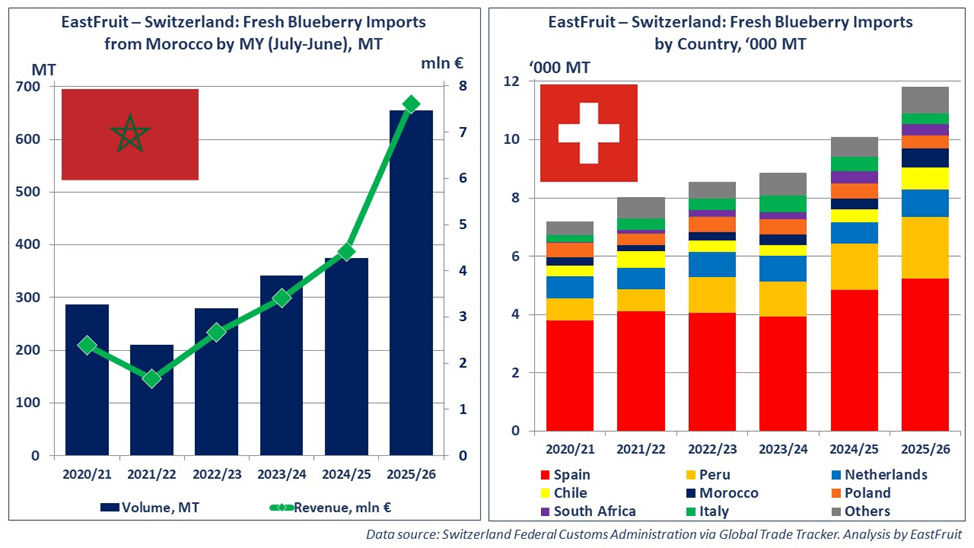
Switzerland’s blueberry market is relatively small in volume but premium in nature, and heavily dependent on imports. Imports have risen for five consecutive years, growing by an average of 10 percent annually. In MY 2025/26, total blueberry imports reached 11,800 tons, up 17 percent year‑on‑year. For Morocco, Switzerland is attractive primarily as a high‑value market rather than one of large physical volumes. Moroccan blueberries are shipped from November through June, with peak volumes in spring, coinciding with Switzerland’s highest seasonal demand.
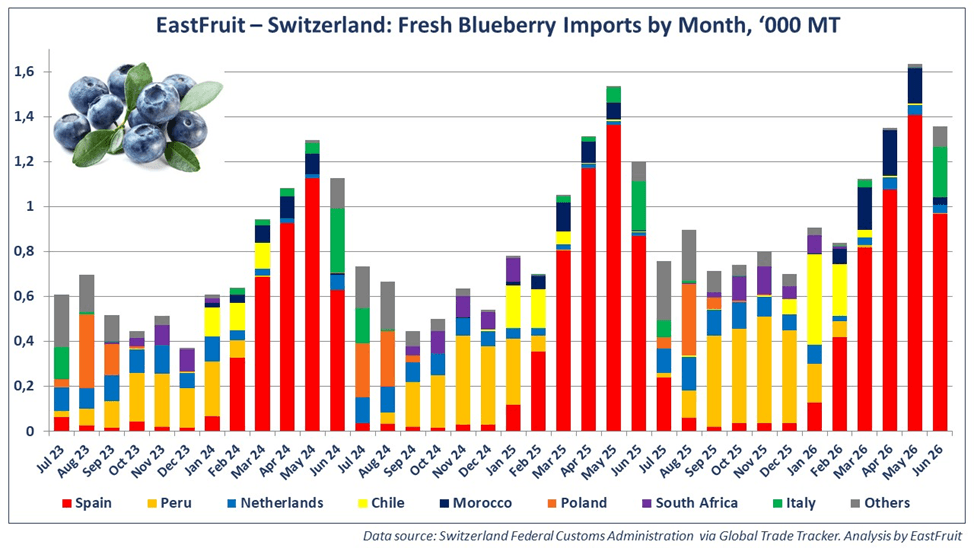
Spain remains the dominant supplier, accounting for 44 percent of imports in MY 2025/26, followed by Peru (17.8 percent), which covers the autumn and early winter window. The Netherlands holds third place with 7.8 percent, acting as a year‑round logistics and re‑export hub. Chile (6.4 percent) supplies during the winter gap, while Poland (3.6 percent) covers the summer. South Africa (3.4 percent), Italy (3.0 percent), and Morocco (5.5 percent) compete directly with Spanish volumes.
In MY 2025/26, imports from Poland, Italy, and South Africa declined, while shipments from Spain, Peru, the Netherlands, Chile, and Morocco increased. Among these, Morocco recorded the strongest growth, enabling it to surpass several competitors and enter Switzerland’s top five blueberry suppliers for the first time.
The use of the site materials is free if there is a direct and open for search engines hyperlink to a specific publication of the East-Fruit.com website.