

After two consecutive years of decline, Egypt significantly increased its palm date exports to Indonesia in marketing year (MY) 2024/25, surpassing previous benchmarks and setting a new volume record, according to EastFruit.
Between July 2024 and June 2025, Egypt exported 25.5 thousand metric tons of palm dates to Indonesia, with a total value of $23.8 million. This marks a 56% increase compared to MY 2023/24 and a 25% rise over MY 2022/23. The volume also exceeded the previous record set in MY 2021/22 by 500 tons. However, the export value fell short of the all-time high of $30.7 million.
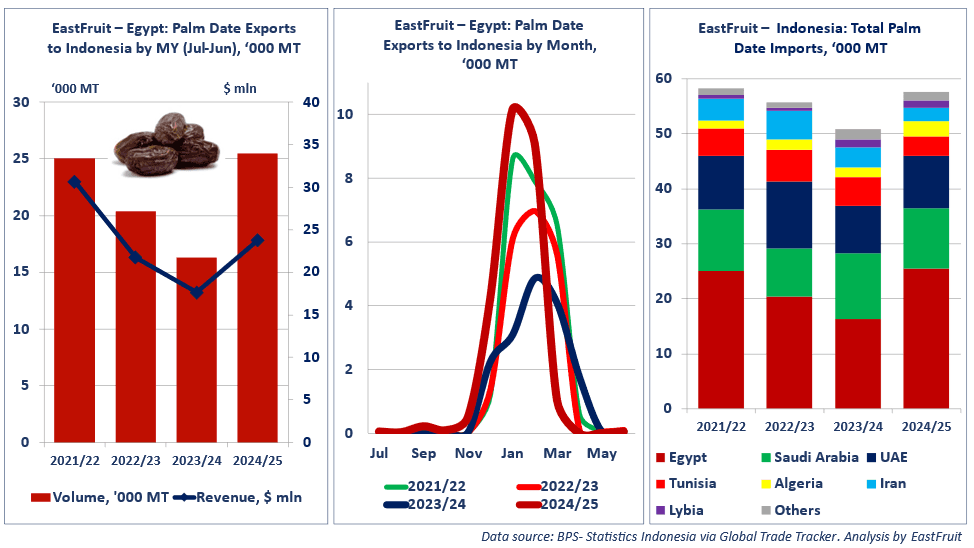
Indonesia remains one of Egypt’s most important destinations for palm date exports, second only to Morocco in terms of volume. Shipments to Indonesia account for approximately 30% of Egypt’s total palm date export portfolio.
Egypt first entered the Indonesian market in MY 2006/07 with a modest shipment of 835 tons. By MY 2007/08, exports had surged to 4,000 tons. Since then, volumes have steadily increased, peaking at 25,000 tons in MY 2021/22.
The following two marketing years were challenging for Egyptian exporters. MY 2023/24 saw a sharp decline to just 16.3 thousand tons, largely due to disruptions in Red Sea shipping routes caused by the Houthi blockade. In MY 2024/25, logistical conditions improved, enabling Egypt not only to recover lost ground but to exceed previous export volumes.
Read also: Egyptian Medjool Date Season 2025/26: Strong Quality, Rising Volumes, and Global Market Ambitions
Egypt retained its position as the leading supplier of palm dates to Indonesia, accounting for 44% of total imports in MY 2024/25. The peak export window falls in January and February, during which Egypt dominates the Indonesian market. For example, Egyptian palm dates made up 61% of Indonesia’s imports in January 2025 and 55% in February.
Saudi Arabia and the UAE ranked second and third among exporters, jointly contributing 35.5% of Indonesia’s palm date imports. The remaining market share was distributed among Tunisia, Algeria, Iran, and Libya.
Import trends over the past four marketing years highlight Indonesia’s reliance on Egyptian palm dates. The decline in total imports between MY 2022/23 and MY 2023/24 was primarily driven by reduced Egyptian shipments. As Egypt ramped up exports in MY 2024/25, Indonesia’s overall import volumes rebounded accordingly.
Egypt is also actively expanding its palm date exports to other markets, including Turkey, where volumes continue to grow.
The use of the site materials is free if there is a direct and open for search engines hyperlink to a specific publication of the East-Fruit.com website.