
The FAO-EBRD regional project for the MENA region, “FAO/EBRD Food Security Package SEMED: Diversifying and Adding Value to Export Markets,” launches a series of publications examining the outcomes of trade missions involving Egyptian and Moroccan exporters to Central Asia (Uzbekistan), Eastern Europe (Poland), and Southeast Asia (Singapore and Malaysia) between 2023 and 2025. The series explores developments in fruit and vegetable imports across these target markets and assesses emerging trade opportunities following these business matchmaking initiatives.
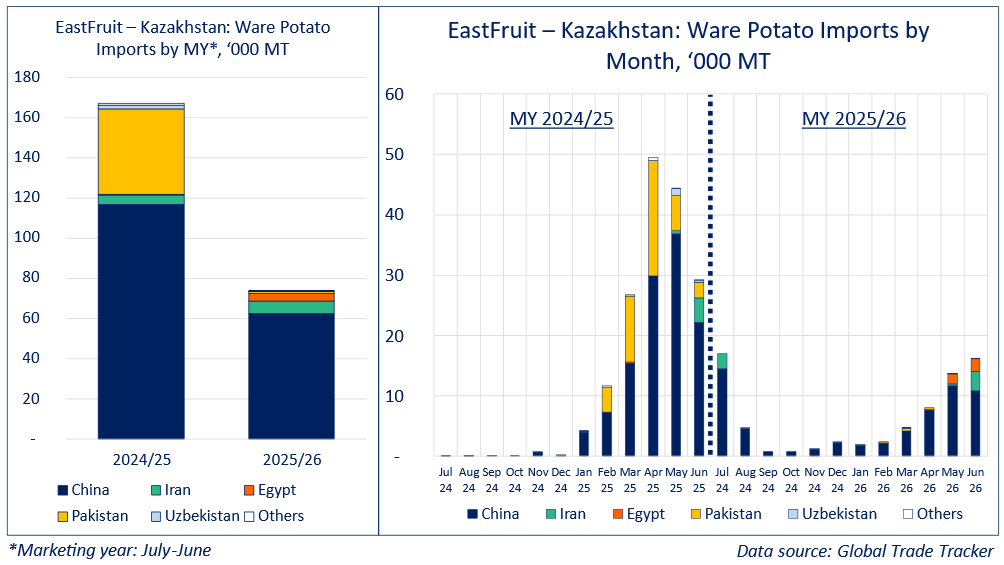
In marketing year (MY) 2024/25 (July-June), Egypt successfully shipped its first commercial consignment of ware potatoes to Kazakhstan, with 220 tonnes entering the market. The breakthrough was followed by rapid growth in MY 2025/26, when imports of Egyptian potatoes increased sharply to approximately 4,000 tonnes. This development highlights the growing competitiveness of Egyptian potatoes in Central Asia and creates new opportunities for exporters seeking to expand their presence across the region.
Potatoes represent a strategically important crop for both Egypt and Central Asia. In 2025, potatoes ranked as Egypt’s third-largest horticultural export commodity after oranges and frozen strawberries, generating export revenues of approximately USD 500 million and export volumes close to one million tonnes. At the same time, Central Asia is home to Uzbekistan, the world’s largest importer of ware potatoes for fresh consumption, with annual imports typically ranging between 500,000 and 700,000 tonnes. Kazakhstan, meanwhile, is both a major producer and exporter of potatoes, regularly exporting between 300,000 and 500,000 tonnes annually. Nevertheless, seasonal fluctuations in production and stocks can periodically create substantial import demand.
MY 2024/25 was a clear example of this dynamic. Following a significant decline in domestic inventories, Kazakhstan’s potato imports accelerated during the spring and reached 167,000 tonnes. The increased demand attracted suppliers from China, Iran, Pakistan and several other origins, including Egypt, with the latter entering the market for the first time with a trial shipment. In MY 2025/26, Kazakhstan’s total potato imports more than halved to 74,000 tonnes. Despite the reduced overall import volume, Egypt succeeded in significantly expanding its market share, demonstrating the growing acceptance of Egyptian potatoes among regional buyers.
Although China remains Kazakhstan’s largest potato supplier and maintains a year-round market presence, it is not necessarily Egypt’s direct competitor. Egypt benefits from a distinct seasonal advantage, as its export campaign begins during the Northern Hemisphere winter. This allows Egyptian exporters to supply markets at a time when stocks of the previous domestic crop are declining and the new harvest has not yet entered the market. In many countries, Egyptian potatoes are marketed as “new” or “early” potatoes, enabling exporters to achieve premium prices compared with stored domestic produce or competing imports. Similar market conditions exist in Central Asia.
The arrival of Egyptian potatoes in Central Asian markets coincided with a period of tight regional supply, preceding the availability of new-season crops from Iran and several Central Asian producers. In Uzbekistan, for example, imports typically increase during the transition period before early domestic harvests reach commercial volumes. The country also relies heavily on potato imports from Kazakhstan, making regional supply dynamics particularly important for market stability.
Moreover, the outbreak of the Iranian conflict in late February 2026 not only affected Iran’s export capacity but also disrupted regional trade flows more broadly. Exports from Pakistan to Central Asia were also negatively impacted, reducing the availability of supplies from traditional origins. As a result, alternative suppliers, including Egypt, were able to strengthen their presence in Central Asian markets and capitalize on emerging opportunities.
Another factor reshaping trade opportunities in the region has been the ongoing war in Ukraine, which continues to create logistical challenges for Egyptian exports destined for Black Sea markets, including Russia, one of Egypt’s leading destinations for horticultural products. The Black Sea region also plays an important role in the routing of Egyptian exports to Central Asia. However, security concerns and operational constraints have reduced the attractiveness of Russian ports, including Novorossiysk, for civilian shipping and container traffic.
Historically, part of Egypt’s exports to Central Asia transited through Russian ports, which complicated the accurate identification of final destination markets in trade statistics. At the same time, alternative logistics routes are gaining importance. In particular, the Caucasus-Caspian corridor, utilizing Georgia’s port of Poti, offers Egypt an opportunity to strengthen its trade links with Central Asia. The further development of this route could facilitate increased exports not only of potatoes but also of a broader range of Egyptian horticultural products to the region.
The opportunities presented by Central Asia were highlighted during the FAO-EBRD trade mission to Tashkent, Uzbekistan, in May 2024. The event brought together 11 exporters from Egypt and Morocco with 20 leading importers and supermarket chains from Uzbekistan, Kazakhstan and other countries across the region. Through a series of B2B meetings, participants explored commercial opportunities for Egyptian suppliers of potatoes, oranges, mandarins, dates, fresh strawberries and mangoes, as well as niche premium-market opportunities for Moroccan exporters of easy-peelers, fresh berries and avocados.
While Central Asia remains a relatively small destination for exports from Egypt and Morocco, its growing import demand and expanding retail sector make it an increasingly attractive market for export diversification. Improvements in transport connectivity and logistics corridors could further support trade growth between North Africa and the region in the coming years.
The use of the site materials is free if there is a direct and open for search engines hyperlink to a specific publication of the East-Fruit.com website.