
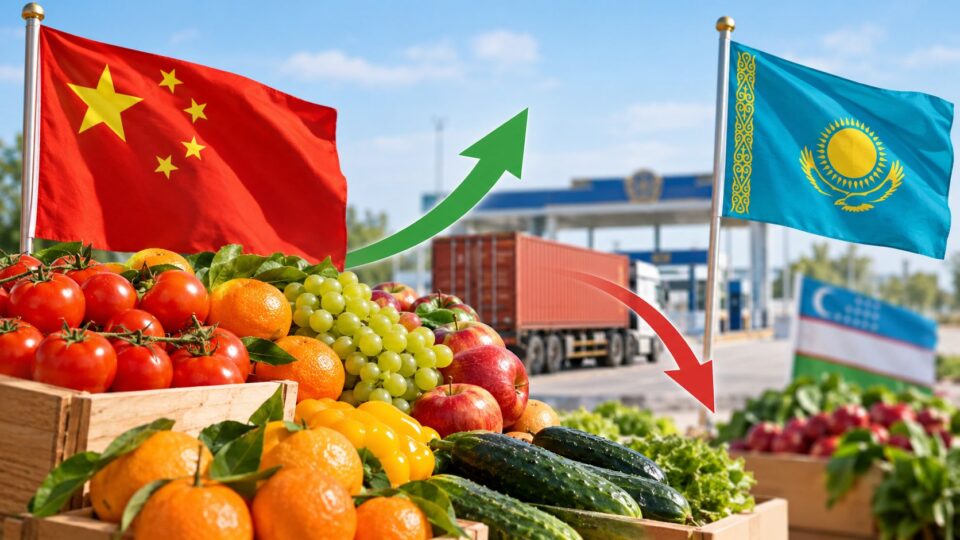
China is rapidly strengthening its position in Kazakhstan’s food market, increasing supplies of fresh fruit and vegetables and pushing traditional competitors aside. Over the past five years, the value of Chinese fruit and vegetable imports has more than doubled, while supplies from Uzbekistan have declined significantly, EastFruit reports, citing APK Novosti news agency.
According to the Tradereport analytical portal, Kazakhstan imported $308 million worth of food products from China in January–July 2026, compared with $105 million in the same period of 2021. China’s share of Kazakhstan’s food imports increased from 4.7% to 8.2%, while import volumes rose fivefold, from 85,000 to 440,000 tonnes. Meanwhile, the average price of Chinese products fell from $1.24 to $0.70 per kg.
China has already overtaken Uzbekistan to become Kazakhstan’s leading supplier of fruit and vegetables. In the first seven months of 2026, Chinese shipments reached $150 million, compared with $94 million from Uzbekistan. In 2021, the situation was reversed, with Uzbek products valued at $138 million and Chinese supplies at $67 million.
The shift has been particularly striking in the tomato market. Over five years, Kazakhstan’s imports of tomatoes from Uzbekistan fell from $15.7 million to $500,000, while supplies from China increased from $1 million to $11.5 million.
Chinese citrus imports have recorded the fastest growth. During the period under review, their value reached $42 million, six times the 2021 figure. Chinese products now account for around 80% of Kazakhstan’s citrus imports, with an average price of approximately $0.45 per kg.
Supplies of other products have also increased substantially. Imports of canned fruit and nuts from China rose from $2.5 million to $32 million, grape imports reached $12.7 million, and imports of apples and pears climbed from $700,000 to $9.9 million. In addition, imports of duck meat and offal reached $14.5 million, compared with just $81,000 five years earlier.
According to Tradereport, China has become Kazakhstan’s largest supplier in 11 product categories with import values exceeding $3 million. In 2021, it led in only four such categories.
Chinese suppliers are also approaching the top position in other fruit and vegetable segments. For example, Kazakhstan’s imports of stone fruit — peaches, apricots and sweet cherries — from China amounted to $12.9 million, compared with $14.6 million from Uzbekistan. In 2021, Uzbek supplies alone had reached $50 million.
China is also narrowing the gap with russia in the canned fruit and nuts segment, with supplies worth $32 million compared with $49 million from russia. Other potential areas of competition include dates, avocados and pineapples, where Chinese shipments are valued at $6.3 million, compared with $9.6 million from Iran.
Despite its rapid growth, China still lags far behind russia in Kazakhstan’s overall food market. Russian products account for around 49% of Kazakhstan’s food imports, valued at $1.86 billion. One of russia’s key competitive advantages is that both countries are members of the Eurasian Economic Union (EAEU), which facilitates the movement of goods and simplifies customs procedures.
However, the example of Belarus, another EAEU member, shows that Chinese suppliers can outperform even partners within the regional trade bloc.
Analysts attribute China’s expansion primarily to its combination of competitive prices and well-developed logistics. Chinese fruit and vegetables reach Kazakhstan year-round, including through the Khorgos border crossing, allowing them to compete with seasonal produce from neighbouring countries.
For Kazakhstani retail chains, this creates opportunities to source products at more attractive prices. At the same time, the structure of the country’s imports is changing: Kazakhstan is becoming increasingly dependent on Chinese agricultural supplies instead of relying primarily on fruit and vegetables from Uzbekistan.
Nevertheless, growth has already slowed in some product categories. During the period under review, imports of Chinese fruit and vegetables declined by approximately 5%, while overall food imports from China continued to increase, rising by 18%.
The use of the site materials is free if there is a direct and open for search engines hyperlink to a specific publication of the East-Fruit.com website.