
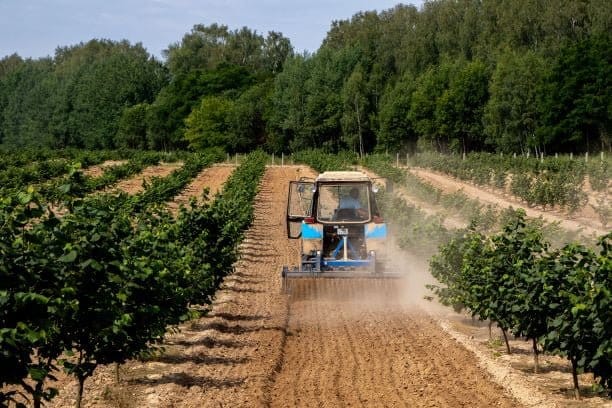
Seasonal labour costs in Georgia’s hazelnut sector have almost tripled over the past four to five years, putting growing pressure on small farms, reducing orchard maintenance and raising concerns over the country’s future production and export potential.
The cost of seasonal labour in Georgia’s hazelnut sector has nearly tripled over the past four to five years, rising from around GEL 35 to approximately GEL 100 per day, and in some cases even higher. For small-scale farms, this sharp increase is significantly undermining production economics and has already led many growers to reduce the amount of work carried out in their orchards, EastFruit reports, citing Business Georgia.
Some farmers have cut spending on orchard maintenance, while others have even abandoned harvesting altogether because revenues from the sale of unshelled hazelnuts were insufficient to cover labour costs.
According to industry estimates, more than 20% of farmers may have failed to carry out all necessary orchard operations. This creates risks for both yields and product quality, not only in the current season but also in the years ahead.
The challenge is particularly acute for small-scale producers. Around 65% of Georgia’s hazelnut farms cover less than one hectare. At this scale, rising expenditure on orchard maintenance, harvesting and other seasonal operations can substantially reduce profitability.
Read also: Hazelnut exports from Georgia are growing much faster in value than in volume
Market participants believe the sector needs more than short-term support during the harvest period. They are calling for a systematic approach to working with growers, ranging from agronomic advisory services to regular on-the-ground support for farms in producing regions.
A similar coordinated approach has delivered results in the past. During efforts to control the brown marmorated stink bug, cooperation between the government and market participants helped increase Georgia’s hazelnut exports from around 30,000 tonnes to approximately 55,000 tonnes within several years.
Today, however, the industry faces a different set of challenges. Alongside crop protection, labour costs, orchard maintenance expenses and the economic sustainability of small farms are becoming increasingly important.
Reduced orchard care — or farmers leaving production altogether because of rising costs — could result not only in lower harvests in the short term, but also in a gradual contraction of Georgia’s hazelnut production base.
Supporting small-scale growers is therefore becoming one of the key conditions for preserving the country’s hazelnut production capacity and export potential.
The use of the site materials is free if there is a direct and open for search engines hyperlink to a specific publication of the East-Fruit.com website.