

With global trade in fresh apples down by more than 20% over the past decade, countries that are increasing their imports have become particularly valuable customers. In my previous blog posts, I examined successful exporters and those that have lost the most ground. Now, I turn to apple importers to explore why some countries are buying more apples from abroad. My conclusions for exporters will be provided at the end of the article.
I analysed international trade statistics for fresh apples, comparing average annual imports in 2016–2018 with those in 2022–2024. Three-year averages help smooth fluctuations caused by weather, harvest volumes and temporary market disruptions.
Where is demand for imported apples actually growing?
Let us first look at a large picture – the regions and then zoom into the individual countries.
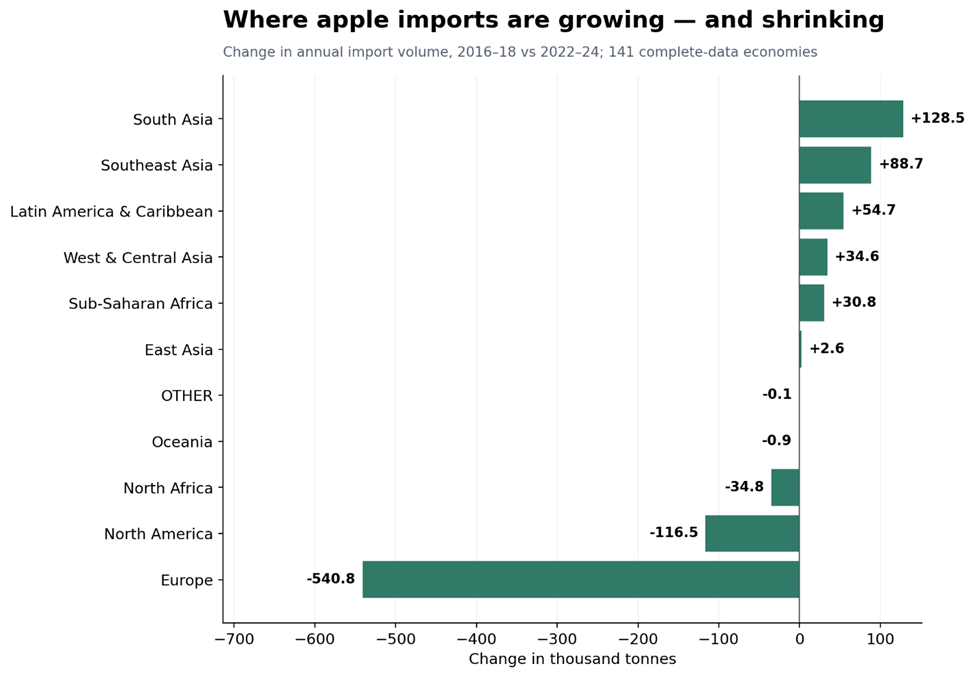
The largest increase in import volumes came from South Asia, where average annual purchases rose from approximately 363,000 to 491,000 tonnes, an increase of 128,500 tonnes, or 35%. This corresponds to annualised growth of about 5.2%.
Southeast Asia came second, adding nearly 89,000 tonnes, or 13%. Latin America and the Caribbean followed with an increase of approximately 55,000 tonnes, while West and Central Asia gained 35,000 tonnes.
Sub-Saharan Africa also deserves attention. Its imports increased by approximately 31,000 tonnes, which may look insignificant compared with South Asia. However, the percentage growth was almost 20%, equivalent to around 3% annually. The market is still relatively small, but it is moving in the opposite direction from Europe.
Meanwhile, the traditional import markets have been contracting. European imports declined by approximately 541,000 tonnes, or nearly 20%. North America lost another 116,000 tonnes, representing around 30% of its earlier import volume. North Africa also recorded a reduction of approximately 35,000 tonnes.
The contrast is striking. International opportunities are increasingly concentrated in markets outside the traditional European and North American destinations. But there is an even more interesting finding – India increased imports by approximately 175,000 tonnes, considerably more than the 128,500-tonne net increase recorded across South Asia. Vietnam added 124,000 tonnes, also exceeding the net growth of Southeast Asia. Brazil increased purchases by nearly 70,000 tonnes, more than the entire net gain of Latin America and the Caribbean.
In other words, three countries individually contributed more additional imports than their respective regions did overall. Other countries within those regions were reducing purchases, offsetting part of this growth. This is why exporters should be careful with general statements about growing Asian or Latin American demand. Markets within the same region can move in completely opposite directions.
India, Vietnam and Brazil: three countries every apple exporter is watching
These three countries lead the ranking for growth in apple import volumes and share several characteristics: apples are not among their most traditional fruits; their economies are expanding rapidly, with rising per-capita incomes and changing consumption habits; and they benefit from favourable demographics.
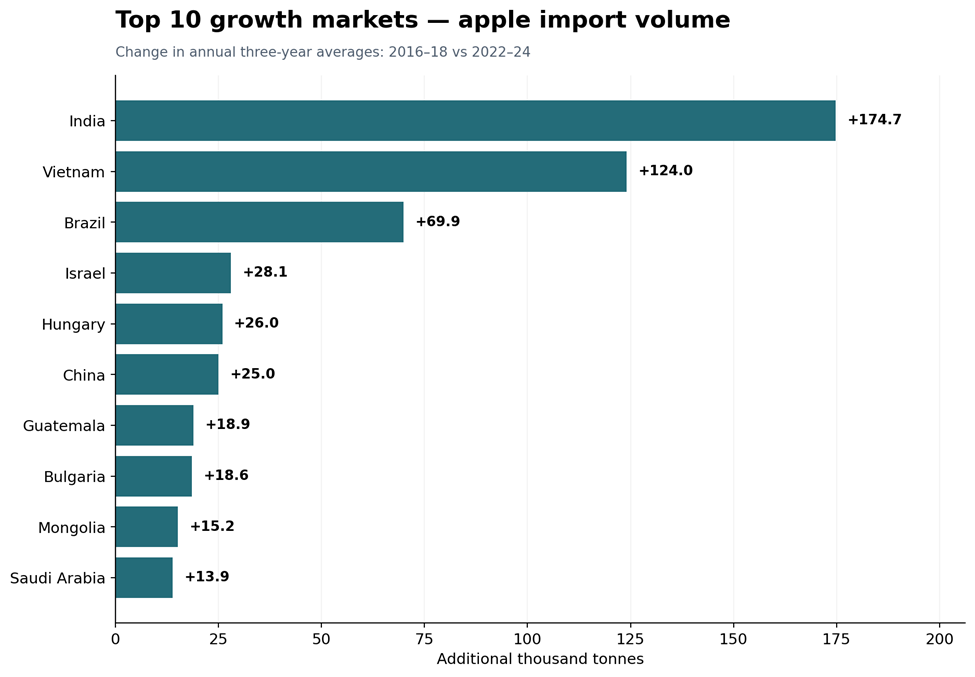
Against the collapse in the global trade, import numbers for these three leaders are really impressive. India increased its average annual imports from approximately 286,000 to 461,000 tonnes, an increase of 175,000 tonnes, or 61%. Vietnam almost tripled its imports, from 62,000 to 186,000 tonnes, gaining 124,000 tonnes. That represents growth of nearly 199%, or approximately 20% annually. Brazil increased purchases from 103,000 to 173,000 tonnes, adding almost 70,000 tonnes, or 68%. Combined, these three markets accounted for approximately 369,000 tonnes of additional average annual apple imports between the two comparison periods. Yet the reasons behind their growth could hardly be more different.
India: a huge market where domestic apples cannot satisfy all demand
India is already one of the world’s largest apple producers, with annual production of approximately 2.5–2.6 million tonnes. So why is it also becoming one of the world’s most attractive import markets? According to USDA, India’s apple consumption is increasing because of population growth, rising incomes, growing interest in healthy food and improved availability of fruit throughout the year. In its 2025 assessment, USDA forecast apple consumption of approximately 3.1 million tonnes in marketing year 2025/26.
Growing demand is only part of the story. India’s apple production and distribution face major structural constraints. Jammu and Kashmir and Himachal Pradesh account for approximately 90% of domestic output, but these mountainous regions are far from many major consumer markets. Weaknesses in transport, cold storage, grading, and post-harvest handling mean that even with production running into millions of tonnes, India struggles to supply distant cities with enough commercially appealing apples.
Check this EastFruit article for more information about typical Indian apple market misconceptions.
Imported apples compete not only on price but also on appearance, sizing, storage life, varieties and consistency of supply. Modern retail and online grocery platforms are making these differences increasingly visible. What is particularly interesting is that India is not exclusively a premium apple market. USDA reports that Iranian apples increased their share of Indian imports from less than 10% before 2019/20 to more than one-third during 2023/24. Affordable imported apples are evidently finding buyers alongside more expensive products from established exporters. This matters because the expansion is being supported by different consumer segments rather than only wealthy households purchasing expensive imported varieties.
India also maintains substantial import restrictions, including tariffs and minimum import-price requirements. Its market access system is extraordinarily complex and not very transparent. Yet imports have grown considerably despite these barriers. The fundamental opportunity therefore appears structural: domestic consumption is increasing, while production, logistics and commercial quality constraints leave room for foreign suppliers.
Vietnam: when imported apples become an everyday product
Vietnam is arguably the most interesting growth story in my analysis. While India’s imports increased by 61%, Vietnam’s expanded by almost 199%, making it the fastest-growing large market among the three leaders. Unlike India and Brazil, Vietnam does not have a substantial conventional apple-growing industry capable of supplying its domestic market.
Just as exotic fruits attract curiosity among European consumers, apples are the exotic fruits in Vietnam. A consumer in Vietnam sends a message that he is modern and prosperous. This is not merely my assumption. Research into Vietnamese consumer behaviour has established a relationship between social status and preferences for imported products.
A 2024 academic study specifically examining imported apples also confirms that they are commonly purchased as gifts, not just for personal consumption. New Zealand’s trade authorities have likewise identified perceived quality, food safety and gift-giving traditions as important factors supporting demand for imported fruit.
But something even more interesting is happening. According to Vietnamese retailers, imported apples are gradually moving beyond the premium gift segment into everyday household consumption. And this is where the real opportunity for exporters lies. Selling an imported apple as a special gift is one business. Making it part of a family’s regular shopping basket is a much bigger one.
Vietnam’s middle class has been growing rapidly, supported by urbanisation, industrialisation and increasing disposable incomes. The purchasing power of consumers in Hanoi, Ho Chi Minh City and other major urban centres has been improving, creating opportunities for imported food products.
Imported apples benefit from rapid expansion modern retail because modern distribution channels can offer better refrigeration, more consistent quality and a wider assortment of varieties and origins. Lower-priced Chinese apples competes in traditional distribution channels, while products from New Zealand, the United States, South Africa and suppliers from the EU serve different quality and price segments. For exporters, Vietnam offers a potentially sustainable opportunity, although success increasingly depends on selecting the right varieties, price segments and commercial partners.
Brazil: a growing import market or a domestic apple industry in trouble?
Brazil is perhaps the most misleading market if we judge opportunities purely by import growth. Its imports increased by approximately 70,000 tonnes between our comparison periods, and the country continued importing substantial volumes afterward.But unlike Vietnam, Brazil has a large domestic apple industry.
Brazilian agricultural researchers at Cepea/ESALQ-USP have documented serious production and quality problems affecting the industry. In 2023, insufficient domestic stocks and a shortage of commercially desirable medium and large-sized apples created additional demand for imported fruits. The situation worsened in 2024. Heavy rainfall during flowering and fruit development reduced production, affected fruit size and increased disease pressure. Domestic suppliers struggled to provide sufficient quantities of the apples demanded by buyers.
Brazil did not simply need more apples; it needed fruit of the right size and quality. To understand the rapid growth in apple imports, I think we should look beyond apples: Brazil also increased imports of fresh oranges, despite being the world’s largest orange producer. In my view, more demanding consumers with greater purchasing power, rather than poor weather in production zones, are driving this growth.
Who else is buying more apples?
Three other countries deserve attention because they demonstrate how different the economics of import growth can be.
Israel increased its average annual imports from approximately 28,000 to 56,000 tonnes, almost doubling the volumes. The additional 28,000 tonnes make it the fourth-largest growing market by absolute volume in our comparable dataset.
Hungary increased imports from around 20,000 to 46,000 tonnes, an expansion of approximately 129%. This is especially interesting because Hungary is itself an apple producer. European Commission market-monitoring discussions have identified fragmented production, ageing orchards, high costs, weather damage and inadequate integrated cold-storage capacity as major challenges facing Hungarian growers. Increased imports may therefore reflect weaknesses in the domestic production and marketing system rather than rapidly rising consumption.
China increased its average annual imports from approximately 67,000 to 92,000 tonnes, a gain of 25,000 tonnes. This might seem absurd for a country producing close to 48 million tonnes of apples annually. But the explanation is commercial segmentation. USDA identifies demand for differentiated imported varieties such as Envy, Ambrosia, Pacific Rose and Cosmic Crisp, particularly among higher-income urban consumers. China can be an enormous producer and simultaneously an attractive destination for premium imported apples. Its import market, however, remains tiny relative to domestic production.
These three countries demonstrate that import growth does not necessarily require a growing population or declining domestic apple output. It can also reflect changing product preferences, insufficient local quality or weaknesses in domestic distribution.
The most important lesson for apple exporters
In my view, selling more apples to people who grew up eating them every day is a challenge: they may prefer to pay a little extra for a mango or papaya. For those who grew up eating papayas, however, an apple may hold the same exotic appeal.
I believe apple exporters could earn better returns on their promotional spending in these markets than by investing heavily in “an apple a day” campaigns where apples are already a dietary staple. Over the next decade, I expect apple consumption to grow substantially in Sub-Saharan Africa and parts of South Asia.
New opportunities can also emerge for other reasons, such as the opening of previously inaccessible markets. Regular market monitoring is therefore essential for successful exporters.
The use of the site materials is free if there is a direct and open for search engines hyperlink to a specific publication of the East-Fruit.com website.
